Your Health, We Care
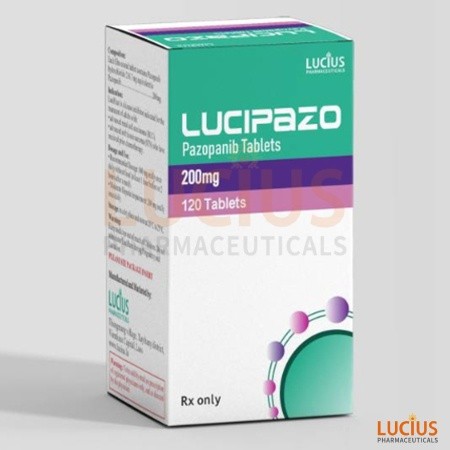
Another NameVotrient、帕唑帕尼、维全特
Indications
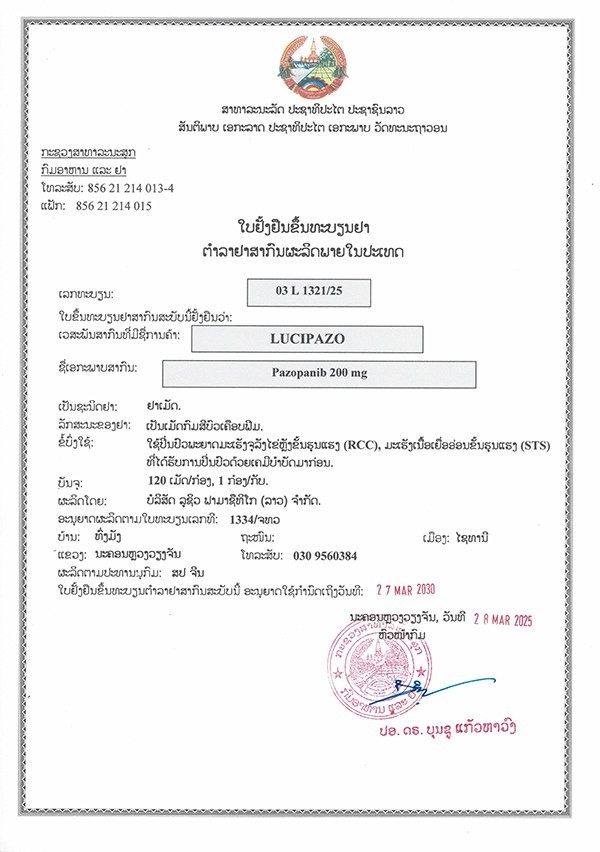
Pazopanib (LUCiPazo) is indicated for adult patients with advanced renal cell carcinoma (RCC) and adult patients with advanced soft tissue sarcoma (STS) who have previously received chemotherapy.
Specs

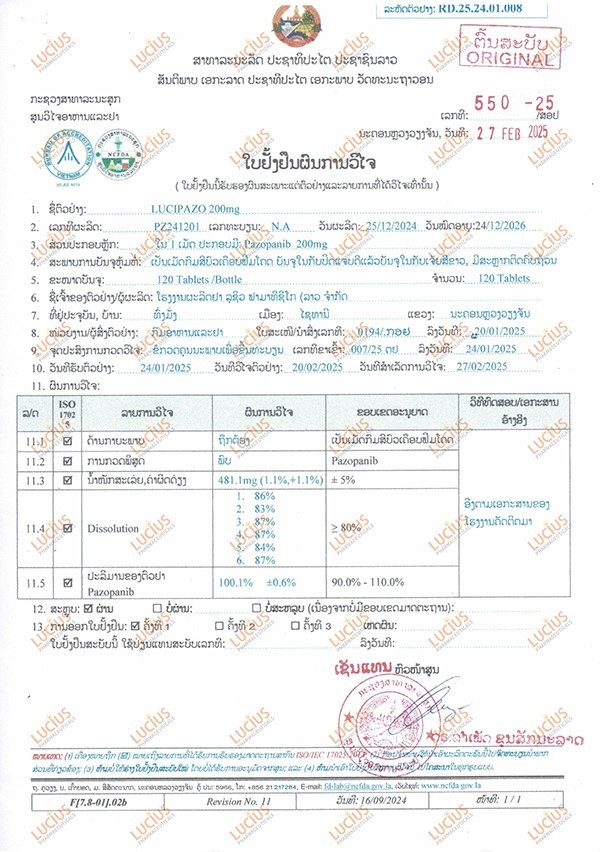
Factory:Lucius Pharmaceuticals
Reg No.:03 L 1321/25
Inspection No.:550-25
Dosage form:Tablet
Indate:24 months
Pazopanib (LuciPazo) is a multi-target tyrosine kinase inhibitor supplied as oral film-coated tablets, indicated for adult patients with advanced renal cell carcinoma (RCC) and adult patients with advanced soft tissue sarcoma (STS) who have previously received chemotherapy.
Severe and even fatal hepatotoxicity has been observed in clinical trials. Monitor liver function and interrupt, reduce, or discontinue dosing as recommended.
The following screenings and assessments should be completed before initiating Pazopanib (LUCiPazo) treatment.
First, liver function. Obtain baseline liver function tests, including alanine aminotransferase (ALT), aspartate aminotransferase (AST), and bilirubin.
Second, electrocardiogram and electrolytes. Monitor baseline electrocardiogram (ECG) and electrolytes (including calcium, magnesium, and potassium).
Third, blood pressure. Patients with uncontrolled hypertension should not initiate Pazopanib (LUCiPazo) treatment; optimize blood pressure before initiating Pazopanib (LUCiPazo) treatment.
Fourth, cardiac function. For patients at risk of cardiac dysfunction (including prior anthracycline exposure), assess left ventricular ejection fraction (LVEF) at baseline.
Fifth, urine protein. Perform baseline urinalysis before initiating treatment.
Sixth, thyroid function. Obtain baseline thyroid function tests.
Seventh, pregnancy status. Verify pregnancy status in women of reproductive potential before initiating Pazopanib (LUCiPazo) treatment.
Eighth, medical history. Pazopanib (LUCiPazo) has not been studied in patients with a history of hemoptysis, cerebral hemorrhage, or clinically significant gastrointestinal bleeding within the past 6 months, or in patients who have had an arterial thromboembolic event within the past 6 months.
Monitoring should be performed during treatment according to the following time points and parameters.
First, liver function. Monitor liver function at baseline and at Weeks 3, 5, 7, and 9, and Months 3 and 4, and periodically thereafter as clinically indicated. For patients with ALT elevation, increase to weekly monitoring until ALT recovers to Grade 1 or baseline.
Second, ECG and electrolytes. Monitor ECG and electrolytes (e.g., calcium, magnesium, potassium) at baseline and as clinically indicated; monitor closely in patients at significant risk of QT prolongation.
Third, blood pressure. Monitor blood pressure as clinically indicated and initiate and adjust antihypertensive treatment as needed.
Fourth, urine protein. Perform baseline and periodic urinalysis during treatment, and follow up with 24-hour urine protein measurement as clinically indicated.
Fifth, thyroid function. Monitor thyroid function at baseline, during treatment, and as clinically indicated.
Sixth, cardiac function. Monitor for clinical signs or symptoms of congestive heart failure; for patients at risk of cardiac dysfunction, perform baseline and periodic LVEF assessment.
Seventh, other. Monitor for pulmonary symptoms suggestive of interstitial lung disease/pneumonitis, signs and symptoms of thrombotic microangiopathy (TMA), signs and symptoms of venous thromboembolism (VTE) and pulmonary embolism (PE), signs and symptoms of infection, and closely monitor patients at risk of tumor lysis syndrome (TLS).
No routine prophylactic premedication is required for Pazopanib (LUCiPazo).
Consider appropriate prophylaxis in patients at risk of tumor lysis syndrome (TLS), i.e., those with rapidly growing tumors, high tumor burden, renal impairment, or dehydration.
Correct hypokalemia, hypomagnesemia, and hypocalcemia before initiating and during Pazopanib (LUCiPazo) treatment.
Patients with uncontrolled hypertension should not initiate Pazopanib (LUCiPazo) treatment; optimize blood pressure before initiating treatment.
Pazopanib (LUCiPazo) is administered orally and should be swallowed whole. Do not crush tablets because crushing may increase the rate of absorption and thereby affect systemic exposure.
Pazopanib (LUCiPazo) should be taken on an empty stomach, i.e., at least 1 hour before a meal or 2 hours after a meal.
The recommended dosage of Pazopanib (LUCiPazo) is 800 mg (four 200 mg tablets) orally once daily on an empty stomach (at least 1 hour before a meal or 2 hours after a meal), continued until disease progression or unacceptable toxicity.
For adverse reactions, the dose reduction schedule for patients with renal cell carcinoma is: first reduction to 400 mg orally once daily; second reduction to 200 mg orally once daily. The dose reduction schedule for patients with soft tissue sarcoma is: first reduction to 600 mg orally once daily; second reduction to 400 mg orally once daily. Patients who cannot tolerate the second reduction should permanently discontinue Pazopanib (LUCiPazo).
Dosage should be adjusted as described in the corresponding sections below for patients with hepatic impairment and patients taking certain concomitant medications.
If a dose is missed and less than 12 hours remain until the next dose, the missed dose should not be taken; simply take the next dose at the regular time. Do not take more than 1 dose at a time.
Patients should be advised: if a dose is missed, take it as soon as remembered; if it is almost time for the next dose (within 12 hours), do not take the missed dose and take only the next dose at the regular time.
Based on animal reproductive study results and its mechanism of action, Pazopanib (LUCiPazo) can cause fetal harm when administered to pregnant women. There are no available data on the use of Pazopanib (LUCiPazo) in pregnant women to evaluate drug-associated risk.
There are no data on whether Pazopanib or its metabolites are present in human milk, the effects on the breastfed child, or the effects on milk production. Because of the potential for serious adverse reactions in breastfed children, advise women not to breastfeed during treatment with Pazopanib (LUCiPazo) and for 2 weeks after the last dose.
Pazopanib (LUCiPazo) can cause fetal harm when administered to pregnant women. Verify pregnancy status in women of reproductive potential before initiating Pazopanib (LUCiPazo) treatment.
Women of reproductive potential should use effective contraception during treatment with Pazopanib (LUCiPazo) and for at least 2 weeks after the last dose.
Men with female partners of reproductive potential (including those who have undergone vasectomy) should use condoms during treatment with Pazopanib (LUCiPazo) and for at least 2 weeks after the last dose.
The safety and efficacy of Pazopanib (LUCiPazo) in pediatric patients have not been established.
No overall differences in the effectiveness of Pazopanib (LUCiPazo) were observed between patients aged ≥65 years and younger patients.
No dose adjustment is required in patients with mild hepatic impairment (total bilirubin ≤ULN and ALT >ULN, or bilirubin >1 to 1.5 times ULN with any ALT value).
Moderate hepatic impairment (total bilirubin >1.5 to 3 times ULN with any ALT value): consider alternative medications; if Pazopanib is truly necessary, reduce the dose to 200 mg orally once daily.
Patients with severe hepatic impairment (total bilirubin >3 times ULN with any ALT value): Pazopanib (LUCiPazo) is not recommended.
Patients with mild and moderate renal impairment: no dose adjustment is required.
Pazopanib is not recommended in patients with severe renal impairment (CrCl < 30 mL/min) or in patients receiving dialysis due to lack of data.
1. Hepatotoxicity
For isolated ALT elevation between 3 times ULN and 8 times ULN, continue dosing and monitor liver function weekly until ALT recovers to Grade 1 or baseline.
For isolated ALT elevation >8 times ULN, withhold dosing until improvement to Grade 1 or baseline; if the potential benefit of resuming treatment is considered to outweigh the risk of hepatotoxicity, resume at a reduced dose not exceeding 400 mg once daily, and monitor serum liver function tests weekly for 8 weeks; if ALT elevation >3 times ULN recurs despite dose reduction, permanently discontinue.
For ALT elevation >3 times ULN accompanied by bilirubin elevation >2 times ULN, permanently discontinue and continue monitoring until resolution.
For patients with only mild indirect (unconjugated) hyperbilirubinemia (i.e., Gilbert syndrome) and ALT elevation >3 times ULN, manage according to the recommendations for isolated ALT elevation.
2. Left ventricular systolic dysfunction
For symptomatic or Grade 3 left ventricular systolic dysfunction, withhold dosing until improvement to <Grade 3, then resume treatment based on medical judgment. For Grade 4, permanently discontinue.
3. Bleeding events
For Grade 2, withhold dosing until improvement to ≤Grade 1, then resume at a reduced dose; if Grade 2 bleeding recurs after dose interruption and reduction, permanently discontinue. For Grade 3 or 4, permanently discontinue.
4. Arterial thromboembolic events
Permanently discontinue for any grade.
5. Venous thromboembolic events
For Grade 3, withhold dosing; if adequate treatment has been received for at least 1 week, resume at the same dose. For Grade 4, permanently discontinue.
6. Thrombotic microangiopathy
Permanently discontinue for any grade.
7. Gastrointestinal perforation
Permanently discontinue for any grade.
8. Gastrointestinal fistula
For Grade 2 or 3, withhold dosing and resume based on medical judgment. For Grade 4, permanently discontinue.
9. Interstitial lung disease/pneumonitis
Permanently discontinue for any grade.
10. Posterior reversible encephalopathy syndrome
Permanently discontinue for any grade.
11. Hypertension
For Grade 2 or 3, reduce the dose as described above and initiate or adjust antihypertensive treatment; if hypertension remains Grade 3 after dose reduction and antihypertensive adjustment, permanently discontinue. For Grade 4 or hypertensive crisis, permanently discontinue.
12. Proteinuria
For 24-hour urine protein ≥3 g, withhold dosing until improvement to ≤Grade 1, then resume at a reduced dose; if 24-hour urine protein ≥3 g does not improve or recurs after dose reduction, permanently discontinue. Permanently discontinue in patients with confirmed nephrotic syndrome.
1. Strong CYP3A4 inhibitors
Avoid concomitant use of strong CYP3A4 inhibitors by switching to alternative medications with no or minimal CYP3A4 inhibitory potential. If concomitant use of a strong CYP3A4 inhibitor is truly necessary, reduce the Pazopanib (LUCiPazo) dose to 400 mg once daily.
2. Strong CYP3A4 inducers
Avoid concomitant use of strong CYP3A4 inducers by switching to alternative medications with no or minimal enzyme-inducing potential. Pazopanib (LUCiPazo) is not recommended in patients who cannot avoid long-term use of strong CYP3A4 inducers.
3. Gastric acid-reducing agents
Avoid concomitant use of gastric acid-reducing agents. If concomitant use of gastric acid-reducing agents cannot be avoided, consider replacing proton pump inhibitors (PPIs) and H2 receptor antagonists with short-acting antacids, and separate the administration of short-acting antacids and Pazopanib (LUCiPazo) by several hours.
4. Simvastatin
Concomitant use increases the risk of ALT elevation. If ALT elevation occurs in patients receiving concomitant simvastatin, increase to weekly liver function monitoring as recommended; withhold Pazopanib (LUCiPazo) based on the severity of hepatotoxicity and resume at a reduced dose, or permanently discontinue.
5. Drugs affecting transporters
Avoid concomitant use with strong P-glycoprotein (P-gp) or breast cancer resistance protein (BCRP) inhibitors; consider alternative medications with no or minimal P-gp or BCRP inhibitory potential.
Hepatotoxicity, manifested as elevations in ALT, AST, and bilirubin, can occur in patients receiving Pazopanib (LUCiPazo) and may be severe or even fatal.
Pazopanib (LUCiPazo) can cause QTc interval prolongation and may induce torsades de pointes.
High-risk populations include patients with a history of QT prolongation, patients taking antiarrhythmic drugs or other drugs that may prolong the QT interval, and patients with relevant underlying cardiac disease.
Cardiac dysfunction, including decreased left ventricular ejection fraction (LVEF) and congestive heart failure, can occur in patients receiving Pazopanib (LUCiPazo).
Bleeding events can occur in patients receiving Pazopanib (LUCiPazo), and fatal bleeding events have been reported.
Arterial thromboembolic events can occur in patients receiving Pazopanib (LUCiPazo) and may be fatal.
Venous thromboembolic events (VTE), including venous thrombosis and fatal pulmonary embolism (PE), can occur in patients receiving Pazopanib (LUCiPazo).
Thrombotic microangiopathy (TMA), including thrombotic thrombocytopenic purpura (TTP) and hemolytic uremic syndrome (HUS), has occurred in clinical trials of Pazopanib (LUCiPazo) as monotherapy, in combination with bevacizumab, and in combination with topotecan.
Monitor for signs and symptoms of gastrointestinal perforation or fistula; for Grade 2 or 3 gastrointestinal fistula, withhold Pazopanib (LUCiPazo) and resume based on medical judgment; for gastrointestinal perforation or Grade 4 gastrointestinal fistula, permanently discontinue Pazopanib (LUCiPazo).
Interstitial lung disease (ILD)/pneumonitis has been reported in clinical trials of Pazopanib (LUCiPazo) and may be fatal.
Posterior reversible encephalopathy syndrome (PRES) has been reported in patients receiving Pazopanib (LUCiPazo) and may be fatal.
Hypertension (systolic blood pressure ≥150 mmHg or diastolic blood pressure ≥100 mmHg) and hypertensive crisis can occur in patients receiving Pazopanib (LUCiPazo).
Impaired wound healing complications can occur in patients receiving drugs that inhibit the vascular endothelial growth factor (VEGF) signaling pathway, and therefore Pazopanib (LUCiPazo) may adversely affect wound healing.
Monitor thyroid function at baseline, during treatment, and as clinically indicated, and manage hypothyroidism appropriately. Inform patients that thyroid function testing will be performed during treatment.
Perform baseline and periodic urinalysis during treatment, and follow up with 24-hour urine protein measurement as clinically indicated; withhold Pazopanib (LUCiPazo) based on the severity of proteinuria and resume at a reduced dose, or permanently discontinue; permanently discontinue in patients with nephrotic syndrome. Inform patients that urine testing will be performed during treatment.
Cases of tumor lysis syndrome (TLS), including fatal cases, have been reported in patients with renal cell carcinoma and soft tissue sarcoma receiving Pazopanib (LUCiPazo).
Serious infections (with or without neutropenia) have been reported, some of which had a fatal outcome.
Pazopanib (LUCiPazo) is not indicated for use in combination with other drugs. Clinical trials of Pazopanib (LUCiPazo) in combination with pemetrexed and lapatinib were terminated early due to increased toxicity and mortality; observed fatal toxicities included pulmonary hemorrhage, gastrointestinal hemorrhage, and sudden death; safe and effective combination doses for these regimens have not been established.
The safety and efficacy of Pazopanib (LUCiPazo) in pediatric patients have not been established, and Pazopanib (LUCiPazo) is not indicated for pediatric patients.
Based on animal study results and its mechanism of action, Pazopanib (LUCiPazo) can cause fetal harm when administered to pregnant women.
Most common adverse reactions (patients with renal cell carcinoma, ≥20%): diarrhea, hypertension, hair color change, nausea, fatigue, decreased appetite, vomiting.
Most common adverse reactions (patients with soft tissue sarcoma, ≥20%): fatigue, diarrhea, nausea, weight decreased, hypertension, decreased appetite, vomiting, tumor pain, hair color change, musculoskeletal pain, headache, dysgeusia, dyspnea, skin hypopigmentation.
Most common laboratory abnormalities (patients with renal cell carcinoma, >10% and ≥5% difference from placebo): ALT increased 53%, AST increased 53%, glucose increased 41%, total bilirubin increased 36%, phosphate decreased 34%, sodium decreased 31%, magnesium decreased 26%, glucose decreased 17%; leukopenia 37%, neutropenia 34%, thrombocytopenia 32%, lymphopenia 31%.
Most common laboratory abnormalities (patients with soft tissue sarcoma, >10% and ≥5% difference from placebo): AST increased 51%, ALT increased 46%, glucose increased 45%, albumin decreased 34%, alkaline phosphatase increased 32%, sodium decreased 31%, total bilirubin increased 29%, potassium increased 16%; leukopenia 44%, lymphopenia 43%, thrombocytopenia 36%, neutropenia 33%.
Concomitant use with strong CYP3A4 inhibitors can increase plasma concentrations of Pazopanib.
Avoid concomitant use of Pazopanib (LUCiPazo) with strong CYP3A4 inhibitors; consider switching to alternative medications with no or minimal enzyme inhibitory potential; if concomitant use of a strong CYP3A4 inhibitor cannot be avoided, reduce the Pazopanib (LUCiPazo) dose to 400 mg once daily.
Concomitant use with strong CYP3A4 inducers may decrease plasma concentrations of Pazopanib. Consider switching to alternative medications with no or minimal enzyme-inducing potential; Pazopanib (LUCiPazo) is not recommended in patients who cannot avoid long-term use of strong CYP3A4 inducers.
Concomitant use with strong P-glycoprotein (P-gp) or breast cancer resistance protein (BCRP) inhibitors may increase plasma concentrations of Pazopanib. Avoid concomitant use of Pazopanib (LUCiPazo) with strong P-gp or BCRP inhibitors; consider alternative medications with no or minimal P-gp or BCRP inhibitory potential. In vitro studies suggest that Pazopanib is a substrate of P-gp and BCRP.
Concomitant use of Pazopanib (LUCiPazo) with the proton pump inhibitor (PPI) esomeprazole can reduce Pazopanib exposure by approximately 40% (AUC and Cmax). Avoid concomitant use of Pazopanib (LUCiPazo) with gastric acid-reducing agents; if concomitant use of gastric acid-reducing agents cannot be avoided, consider replacing PPIs and H2 receptor antagonists with short-acting antacids and separate the administration of short-acting antacids and Pazopanib by several hours to avoid decreased Pazopanib exposure.
Concomitant use of Pazopanib (LUCiPazo) with simvastatin can increase the incidence of ALT elevation. If ALT elevation occurs in patients receiving concomitant simvastatin, increase to weekly liver function monitoring as recommended, and withhold Pazopanib (LUCiPazo) based on the severity of hepatotoxicity and resume at a reduced dose or permanently discontinue. Data are insufficient to assess the risk of concomitant use of other statins with Pazopanib (LUCiPazo).
Concomitant use of Pazopanib (LUCiPazo) with drugs metabolized by CYP3A4, CYP2D6, or CYP2C8 and with a narrow therapeutic window may inhibit the metabolism of these drugs and pose a potential risk of serious adverse reactions; therefore, concomitant use is not recommended.
Pazopanib (LUCiPazo) is associated with QTc interval prolongation; avoid concomitant use with drugs known to prolong the QT/QTc interval.

Lucius Pharmaceuticals (Lao) LTD. (Lucius Pharmaceuticals), with its manufacturing campus in Laos located in the capital city of Vientiane in 2020, officially begins its great journey to make effective and affordable medicines available to people in need around the world...More

Lucius Pharmaceutical Co., Ltd., was established in 2020 in Vientiane, the capital of Laos. It aims to offer safe, effective, and affordable medicines globally. With a factory spanning 25,000 square meters, the company manufactures 200+ generic drugs in diverse therapeutic fields.
Address: No.26 Thongmang village, Xaythany district, Vientiane Capital, Laos
E-mail:laoslucius@gmail.com
Name: Lucius

Telegram name: Vira
No.:0085253923643
Telegram name: Vira
No.:0085253923643